
Sensory processing is the ability to interpret, process, and make sense of the world around us. It forms the foundation for all movement, learning, and behaviors. According to Dr. Jean Ayres, our three foundational sensory systems include the tactile (touch) system, proprioceptive (muscle and joint receptors) system, and vestibular (balance) system (Lane et al., 2019). Ayres Sensory Integration® (ASI) considers this sensory triad as a pivotal factor for the processing of all sensory systems and essential in promoting the building blocks for childhood development. Organizing incoming sensory information from the environment has a significant impact on brain development and subsequent capabilities, such as body awareness and motor planning skills.
Moving through the world with confidence depends on more than strength and coordination. Basic skills, such as zipping a jacket, to more complex skills, such as climbing playground equipment or navigating through the hallways of school, are built upon our foundational sensory systems. These primary senses provide the brain with the essential information about the body’s position, movement, safety, and readiness for action (Miller et al., 2007). Providing appropriate therapeutic input can facilitate sensory system integration and improve body awareness, developmental skills, and optimal progression toward everyday tasks. Appropriately graded sensory input can significantly enhance a child’s body awareness and motor planning abilities.
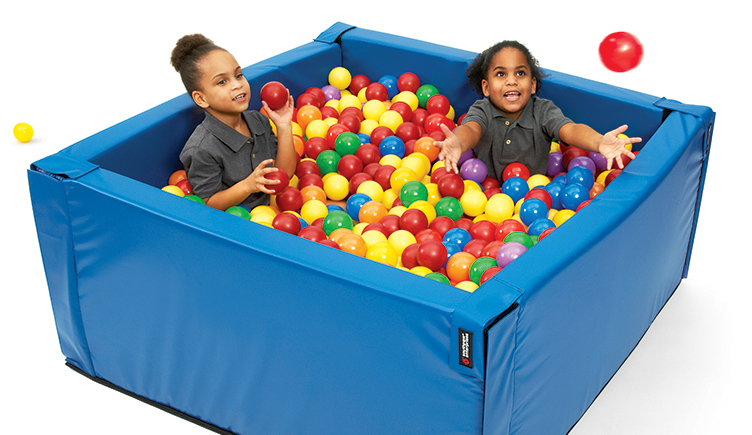
The tactile system delivers information about touch, texture, pressure, and temperature. Tactile input helps children understand where their bodies are in space and how to protect themselves from harm (Ayres, 2005). Children who are overresponders to tactile input, or have tactile defensiveness, can avoid touch, have difficulty with certain textures of clothing, or have difficulty with grooming and hygiene (Bundy et al., 2020). Children who are underresponders to tactile input can have a high pain threshold, be unaware of food on their face, constantly seek out being touched, or seem clumsy and oblivious (Bundy et al., 2020).
The proprioceptive system provides information from muscles and joints regarding body position, force, and timing (Ayres, 2005). A well-integrated proprioceptive system is crucial for smooth, coordinated movement and for adjusting pressure when writing, gripping utensils, or navigating obstacles. Children who are overresponders to proprioceptive input often appear cautious and timid, and can avoid playing on equipment or trying new physical activities (Bundy et al., 2020). Children who are underresponders to proprioceptive input tend to move around frequently, bump into objects, take climbing risks, or fall frequently (Bundy et al., 2020).
The vestibular system, located in the inner ear, provides information regarding changes in head position, movement speed, and direction (Ayres, 2005). It plays an important role in balance, postural control, and bilateral coordination. A well-integrated vestibular system is critical for walking, writing, reading, and participating in sports. Children who are overresponders to vestibular input, or gravitationally insecure, often respond strongly to movement, which can lead to dizziness, nausea, and avoidance of activities such as swinging or car rides (Bundy et al., 2020). Children who are underresponders to vestibular input tend to seek out opportunities for intense movement such as spinning, jumping, and crashing (Bundy et al., 2020). They are often in constant motion and may also present as impulsive.
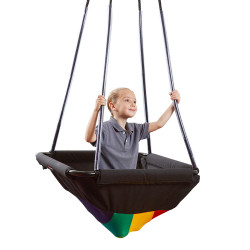
The Rainbow Acrobat Swing is another option that targets the proximal sensory system, as it provides deep pressure to muscles, joints, and touch receptors through its multi-layered hammock design as children move through space. Children build body awareness, strength, and motor planning skills as they climb through each of the four layers. The firm but soft Lycra® layers can also serve as a calming space that feels similar to a hug, to support regulation as sessions conclude. The two-hook design offers gentle linear movement that can produce a calming effect. The amount of input can be graded based on the child’s response to the movement.
The Rainbow Bucket Swing is a great way to provide multisensory experiences for younger children. The bucket frame provides stability as it moves through different planes of motion, while the seated Lycra® fabric provides cushioned yet resistive proprioceptive and secondary tactile input to the lower body. Older children can enjoy the Rainbow Platform Swing, which offers similar properties minus the support of the bucket enclosure. Together, these swings challenge the child to plan, adjust, and stabilize their posture as they receive feedback from the lycra fabric. The Rainbow Platform/Bucket Swings allow for movement in multiple planes of movement, which can support a child’s individualized sensory needs. Activities that promote higher-level motor planning, sequencing, and timing can be facilitated, creating the ideal press for mastery and adaptive response.
Inclusive in design, the Adaptive Climbing Wall offers unique features that provide motor planning opportunities for children with varying needs, including cognitive and physical disabilities. Safety features, including adaptive grips and platform-style foot holds, provide stability for children who require graded support as they navigate and weight shift to ascend, descend, and cross the wall. The surface accepts dry-erase marks and magnetic items, allowing clinicians to pair these enriched sensory experiences with cognitive activities for heightened learning and engagement. The Adaptive Climbing Wall offers graded proprioceptive input while promoting bilateral coordination, postural adjustment, and opportunities to receive feedback on motor planning while moving against gravity.
By integrating equipment into therapeutic practice, opportunities to maximize benefit include grading movement, modifying the complexity of the task, incorporating whole-body tasks, and pairing sensory input with functional goals (Schaaf & Mailloux, 2015). When provided with appropriate therapeutic input that targets each of the tactile, proprioceptive, and vestibular systems, improvements in sensory-motor skills, including motor planning and overall ease of movement, can refine the ability to plan actions and interact with daily tasks. Whether used in learning or in play, these items foster children’s ability to adapt to varying environments for optimal participation.
References
Ayres, A. J. (2005). Sensory Integration and the Child. Western Psychological Services.
Bundy, A. C., Lane, S. J., & Murray, E. A. (Eds.). (2020). Sensory Integration: Theory and Practice (3rd ed.). F.A. Davis.
Lane, S. J., Mailloux, Z., Schoen, S., Bundy, A., May-Benson, T. A., Parham, L. D., Smith Roley, S., & Schaaf, R. C. (2019). Neural foundations of Ayres Sensory Integration®. Brain Sciences, 9(7), 153. https://doi.org/10.3390/brainsci9070153
Miller, L. J., Anzalone, M. E., Lane, S. J., Cermak, S. A., & Osten, E. T. (2007). Concept evolution in sensory integration: A proposed nosology for diagnosis. American Journal of Occupational Therapy, 61(2), 135–140.
Schaaf, R. C., & Mailloux, Z. (2015). Clinician’s guide for implementing Ayres Sensory Integration®: Promoting participation for children with autism. Journal of Autism and Developmental Disorders, 45(4), 1005–1017.