
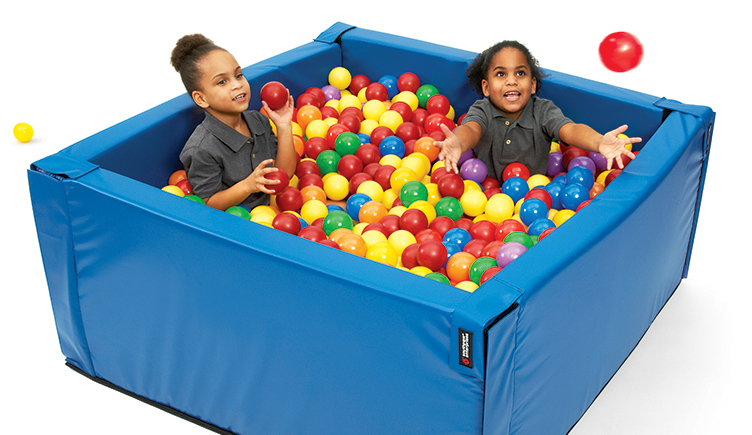
When talking about self-regulation skills, for most clinicians, our thoughts typically gravitate toward the younger population, especially if you are a pediatric therapist. Poor self-regulation often manifests itself early, when a young child has to sit in class and listen to their teacher.
Children who struggle with self-regulation often have Sensory Processing Disorder (SPD). Individuals with SPD, both children and adults, have difficulty interpreting or registering sensory input from their environment. This can include areas of touch, pressure, movement, position in space, sounds, visual input, tastes, and smells. The degree of managing these senses can be as mild as a small tag in a new shirt being interpreted as bothersome or as high as a sound that elicits a person’s fight-or-flight response. It is estimated in one study by Carter et al. (2009) that 1 in every 6 child experiences difficulty with sensory processing, thus impacting self-regulation and the ability to functionally engage in daily routines.
Fortunately, there are professionals and types of interventions that can specifically address sensory processing issues, helping to improve self-regulation and a child’s functioning. Some children are identified early and receive the needed help to support them and their caregivers. Unfortunately, there are many children who are not identified and face challenges, such as being labeled as a child who has a behavioral diagnosis or, even worse, a cognitive disorder. Some children grow into adults facing these sensory challenges with a trailing baggage of childhood difficulties. As adults, some figure out their sensory processing struggles by way of trial and error, or through enlightening education helping them improve and even master their self-regulation, like Temple Grandin did. Temple Grandin, who is autistic, grew up as a child always knowing she was “different” and, today, holds a PhD and is a worldwide designer of livestock equipment. By observing how cattle calmed once being squeezed in a cattle chute, she invented her own “squeeze machine,” helping her to calm and self-regulate (Thinking in Pictures, 1995).
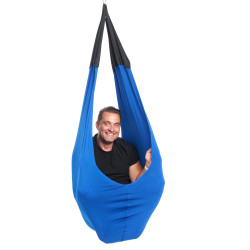
Similar to Temple Grandin’s ability to adjust her environment to meet her needs, this was observed during Rocky Mountain College’s Occupational Therapy Programs open house. Surrounding high schools in Billings, Montana, were invited to visit the program’s facilities and learn more about occupational therapy. High school students and their parents had the opportunity to engage in different activities with occupational therapy students to show what therapists can do to help people. Of the several activities, one vestibular station with suspension swings was a favorite for students. During the tour, there was one high school student who had little engagement with anyone until he saw the Adult Cuddle Swing made by Southpaw Enterprises. After inspecting the swing, the student asked if he could get in. After successfully getting in the swing, this student would not get out. The open house lasted another 30 minutes, then concluded. After all the other high school students had left, this one student remained silent in the swing with smile on his face. His mother, who was with him, said they had to leave soon. As this remaining student sat in the Adult Cuddle Swing, he said only one thing, “My brain feels normal.” His mother just stood and smiled and said her son has always felt “different.” She then asked where she could get a swing like this one and said, “I don’t care how much it costs; I have never seen my son like this!”
This was a great learning experience for occupational therapy students to see how one moment, one child, one piece of equipment helped to make a difference in someone’s self-regulation. It’s estimated that 1 in 20 adults suffers from some type of Sensory Processing Disorder (Van den Boogert, et., al. 2022). Van den Boogert and colleagues also report that many individuals with psychiatric disorders report difficulties with sensory processing. Regardless of the diagnosis, increased awareness of supports for individuals with sensory processing issues needs to be highlighted. Awareness of supports could be as simple as removing a tag from a shirt or as simple as getting into a sensory swing for the first time. Knowing sensory techniques and what supports are available is important for all therapists so, just maybe, we can assist someone by improving their self-regulation, helping them feel “normal.”
References:
Ben-Sasson, Carter, Briggs-Gowen (2009). Sensory Processing Disorder Scientific Work Group.
Boogert, F. V., Klein, K., Spaan, P., Sizoo, B., Bouman, Y. H. A., Hoogendijk, W. J. G., Roza, S. J. (2022). Sensory processing difficulties in psychiatric disorders: A meta-analysis. Journal of Psychiatric Research, 151(6). 173-180.
Grandin, T. (1995). Thinking In Pictures. Knoph Doubleday Publishing Group.
Southpaw Enterprises (2026). https://www.southpaw.com/?srsltid=AfmBOop4X122bmv-oMTTErV8WmMMbT-mogpCGFIiT3j3veVorupnJc5Z