

Feeding is a sensory experience. It involves tactile input as the hands touch food and grasp utensils. It involves visual input, since the way a food appears can shape our willingness to try it—think about the different experience between being served a whole fish versus a fish fillet. It involves olfactory (or smell) input, which is closely tied to the gustatory (or taste) sense. And it involves taste—of course! These senses rarely work one at a time. A single bite asks a child to manage all of them at once, and for many of the kids in feeding therapy, that is a tall order.
Feeding is also a whole-body experience. Sure, the mouth does most of the visible work, but body parts are interconnected. For the mouth to do its job of clearing utensils, chewing, and forming a bolus that is ready to be swallowed, it needs a strong foundation in place. Imagine that the mouth sits atop a stack consisting of the hips, the trunk, the shoulders and the neck. If anything from this stack falls out of alignment, the whole thing tumbles. A child slumped in a chair with feet dangling and unsupported is working much harder to eat than we might realize. As such, feeding therapy may focus on strengthening and sensory input throughout the whole body, as well as the mouth.
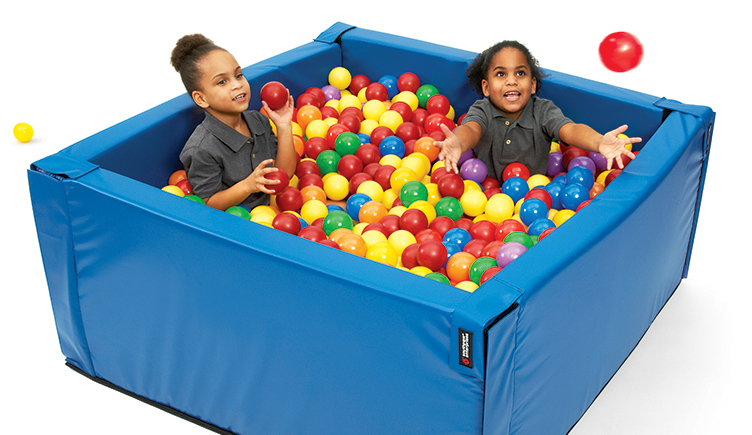
As a feeding therapist, sensory integration specialist and lactation consultant, I structure my sessions to move from proximal to distal, or big muscles to small muscles. The body has to feel stable and organized before the mouth can do the precise, coordinated work of eating. To prepare the whole body, I start my feeding sessions in the gym. Depending on what the child needs that day, I shape a sensory-rich gross motor activity. A child with low muscle tone may spin on a Platform Swing for alerting sensory input to wake the body up. A child with anxiety during mealtimes may benefit from the calming input of a Snuggle Swing. A child with motor planning challenges may get organized with a proprioceptive-rich obstacle course including the Rocking Arch, Riverstones and Crash Pit Steps & Slide. Once the child is regulated, the body is organized, and the postural muscles are activated, we transition to the table for a feeding activity.
The mouth can be warmed up with sensory input and strengthening exercises in a similar way. The Z-Vibe is one of my go-to tools here. It can be used to deliver alerting oral sensory input and to rehearse oral motor skills, such as tongue lateralization and jaw strengthening. Additionally, the vibration may help inhibit and reorganize unfamiliar or nonpreferred oral sensory input after a child explores a new food texture, so it feels a little less overwhelming.
Finally, the key to a successful feeding session is maintaining trust throughout the process, whether we are in the gym or at the table. As with sensory play, the child leads the way, and the occupational therapist follows that child’s lead. Pushing a bite is a fast way to lose that trust. When a feeding activity is playful and pressure-free, a child is far more likely to engage and make progress over time.
When we talk about feeding therapy, we are really talking about far more than the mouth. We are building the stack from the ground up, warming up the body and then the mouth before engaging with any actual food. Protecting the child’s trust is essential at every step along the way. Progress at the table rarely begins at the table—it begins with a regulated, organized and confident child who feels safe enough to explore.