
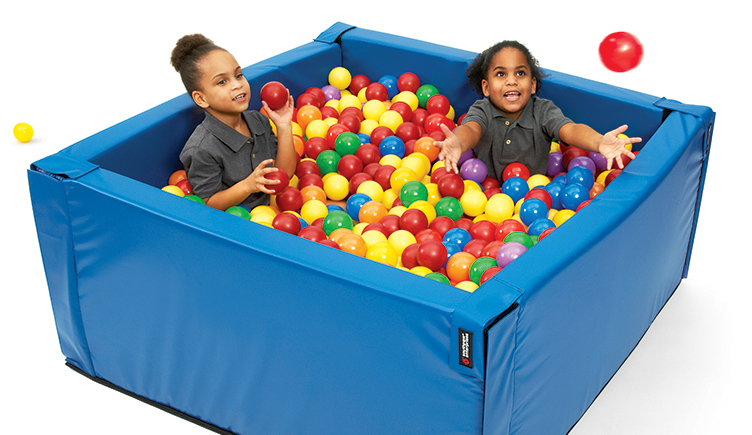
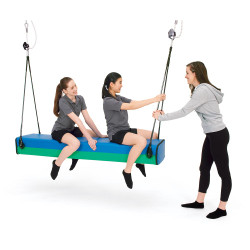
Sensory-motor equipment remains a staple in pediatric occupational therapy. Swings, scooter boards, bolsters, and other equipment create rich opportunities for play and provide a platform for examining the underlying components of movement, self-regulation, and confidence. These tools are especially useful when therapists are able to clearly describe what activity demands are being created with the equipment. They allow therapists to grade those demands and then connect the child’s performance to participation in everyday life.
A clear and pressing priority for occupational therapy education is to help students describe sensory-motor activity demands with greater precision. Currently, students are trained to measure with commonly used caregiver questionnaires, sensory profiles, clinical observations, and individualized goal-attainment approaches. These assessment methods help us understand sensory-adjacent behaviors and family concerns, and they are valuable sources of information. However, they could become even stronger when paired with direct measures of what is happening during activity. A stronger scientific foundation can be built when we can connect reported behavior and functional goals with observable changes in posture, muscle activation, force, timing, gaze, movement quality, and adaptation across changing task demands. (Kishida, Stephenson, Kemp, & Salisbury, 2026).
At Rochester Institute of Technology, we want students to move past equipment familiarity toward sharper clinical reasoning and better measurement. Tools such as motion capture, EMG, force plates, wearable sensors, eye tracking, structured video review, and careful activity analysis make activity demands more visible. As one example, measuring spinal extensor activation during play in a prone net swing can help us ask whether those patterns relate to functional posture during classroom work. Or if we can use eye tracking to understand where a child looks during targeted reaching, we can ask better questions about visual attention, motor planning, and participation in everyday routines.
Swings, bolsters, scooter boards, suspended equipment, and sensory-rich environments already show remarkable clinical creativity. Because of new advancements in measurement, occupational therapists can match that creativity with better evidence and then better understand how activities work. Therapy will improve when clinicians know when equipment is most useful, for whom it is best suited, and how therapeutic experiences support everyday participation outside of the clinic or classroom. Better measurement can help therapists preserve the playfulness and creativity of sensory-motor intervention while strengthening the scientific basis for clinical decision-making.
Reference:
Kishida, Y., Stephenson, J., Kemp, C., & Salisbury, C. (2026). Efficacy of interventions adhering to the revised ayres sensory integration® Fidelity Measure: A systematic review. Journal of Autism and Developmental Disorders, https://doi.org/10.1007/s10803-026-07283-7