

Whether at home or in school, children are nearly constantly using their arms, hands, and fingers to engage in everyday play and learning activities. From imaginary play with friends to zipping a jacket, building with blocks and sand, cutting and coloring at school, crawling and climbing on the playground and much more in between, there is little opportunity for hands to stay idle. In fact, it is estimated that nearly 37%–60% of a child’s elementary school day requires them to use a combination of reaching, grasping, releasing, and manipulating with one or both of their hands (Caramia et al., 2020). These are known as fine motor skills, and in order for children to use them effectively, they require the successful integration of a number of anatomical processes and structures, including stability of proximal musculature in the trunk and shoulder girdle, adequate development of the palmar arches of the hand, and sufficient strength of the intrinsic muscles in the hand.
However, before all else, fine motor skills are foundationally supported by the sensory systems of the brain, specifically the proprioceptive and the tactile systems. Both of these systems support the brain’s ability to know where the fingers and hands are in space, feel and discriminate between objects in the hand, and modulate force of the grasp and pinch of items such as pencils, markers, tweezers, blocks, and other learning or play objects. Ultimately, children rely on adequate integration of their tactile and proprioceptive processing for successful participation in basic childhood activities requiring fine motor skill (Piller & O’Brien, 2025). Occupational therapists (OTs) are healthcare providers who are expertly trained in providing evaluation of and intervention for perceived deficits in fine motor skill and sensory processing systems (AOTA, 2020). When working with children displaying deficits in proprioceptive processing and tactile processing that are impacting their fine motor skills, OTs can choose between a number of tools while utilizing a play-based, client-centered, and evidence-based approach.
First, therapists can consider incorporating suspended equipment that requires a child to hold their body weight against gravity through their hands and arms while swinging. The Trapeze Bar and the Steering Wheel Swing are both great options that require a child to hang from their arms while either actively or passively swinging in linear or rotary patterns. Adding the bungee component can heighten the fun by adding linear vestibular experiences to the possibilities. All of these options allow for movement experiences that may be more engaging and playful, while also providing input through the muscles and joints of the arms, hands, and fingers to stimulate proprioceptive processing for better use of fine motor skill (Piller & O’Brien, 2025).
Climbing and crawling both provide strong proprioceptive input and can be incorporated into endless options for imaginative play using the In-FUN-ity climbing system. Between the wall ladder, climbing net, scooter board ramp with rope attached, and rock wall, therapists have endless options to collaborate with their kids to create creative and open-ended obstacle courses and play schemes with ample weight-bearing opportunity. When these activities are strategically planned and executed, children have the potential for improved awareness of where their fingers and hands are in space when using them for coloring, cutting, writing, building, and more.
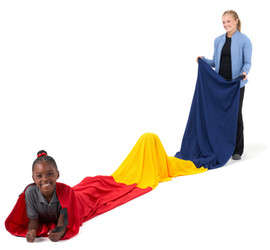
Finally, opportunities to feel resistance through the arms, hands, and fingers also increase body awareness for improved fine motor skills (O’Brien & Kuhaneck, 2025). Theraputty™ can be presented in a variety of resistance levels depending on the abilities of the child, and when presented in a fun and playful way, can support the growth of fine motor skill by not only increasing proprioceptive awareness, but also building intrinsic strength in the hands and fingers. Similarly, tools made of LYCRA® such as the Stretch-Eze®, Body Sox®, and Resistance Tunnel challenge kids to push and pull through their hands, building strength and perception. LYCRA® tools are versatile, accessible, and easily transported between environments so they can be incorporated into nearly any play scheme for increased therapeutic value.
When working with children experiencing fine motor challenges, it can be easy for therapists to focus their attention on fine muscle strength and manual dexterity, which are important to consider for a well-rounded approach. However, it is equally important for therapists to provide ample and robust proprioceptive experiences to create a strong foundation for fine motor skill availability. Fortunately, there are a wide variety of tools available to support these goals in a playful and engaging way!
Caramia, S., Gill, A., Ohl, A., & Schelly, D. (2020). Brief report—Fine motor activities in elementary school children: A replication study. American Journal of Occupational Therapy, 74, Article 7402345010. https://doi.org/10.5014/ajot.2020.035014
Piller, A., & O’Brien, J. (2025). Intervention for Fine Motor Skills. In J. O’Brien & H. Kuhaneck (Eds.), Case-Smith’s occupational therapy for children and adolescents (9th ed., pp. 566–588). Elsevier.
American Occupational Therapy Association (AOTA). (2020). Occupational therapy practice framework: Domain and process (4th ed.). American Journal of Occupational Therapy, 74(Suppl. 2), 7412410010p1–7412410010p87. https://doi.org/10.5014/ajot.2020.74S2001